
SEO vs Google Ads: What Works Better for Indian Small Businesses in 2026?
SEO vs Google Ads for Indian small businesses: compare costs in rupees, speed and results, plus a 90-day plan for Rs. 20,000 to Rs. 30,000 a month.
Smarteer Team
Contents
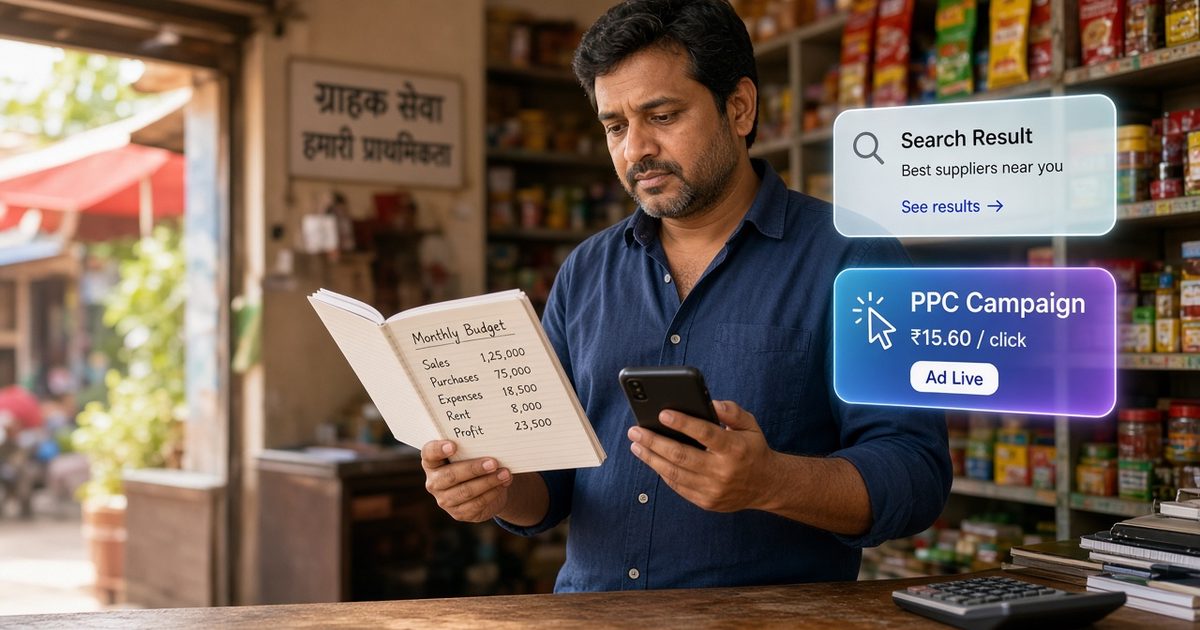
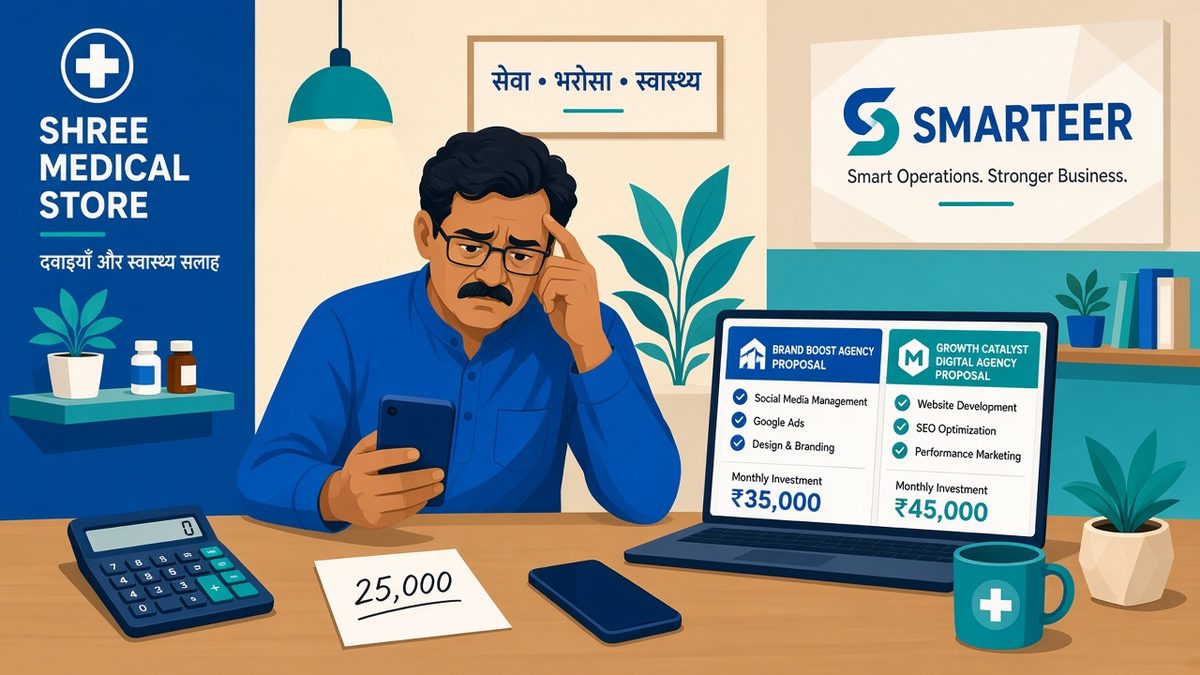
You have Rs. 25,000 a month for marketing, a phone that isn't ringing enough, and two agencies giving you opposite advice. One says run ads now. The other says build your website and rank. The SEO vs Google Ads debate confuses most owners because it's usually framed as a fight, when it's really a question of timing and cash flow.
Here's the honest version. Ads rent you attention from the day you switch them on. SEO builds attention you own, but it takes months. Which one deserves your first rupee depends on your business, your city and how fast you need enquiries.
In this guide you'll learn how each channel works, what Google Ads cost in India looks like in typical ranges, when to pick one over the other, and how to combine them. You'll also get a 90-day plan for a budget of Rs. 20,000 to Rs. 30,000 a month. Let's start with the short answer.
SEO vs Google Ads: The Short Answer
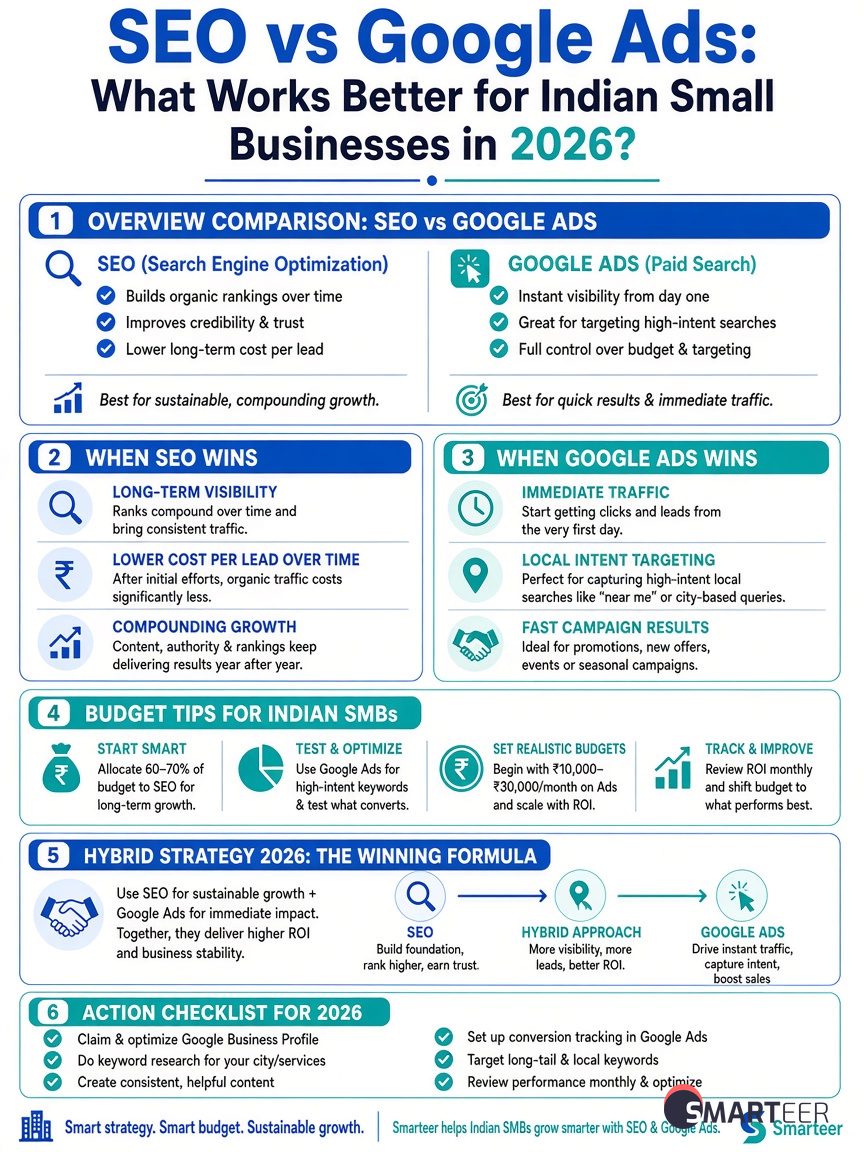
Google Ads buys traffic today. SEO builds traffic you own. Ads stop the moment you stop paying. SEO keeps working after you stop spending, though it slows down if you stop maintaining it.
For most shops, clinics, coaching centres and service firms, the best answer is a mix that changes over time. A new business often leans on ads in the first few months to get enquiries while the website and Google Business Profile mature. An established local business with a tight budget often does the reverse and puts most of its money into search visibility, with a small ad budget for testing.
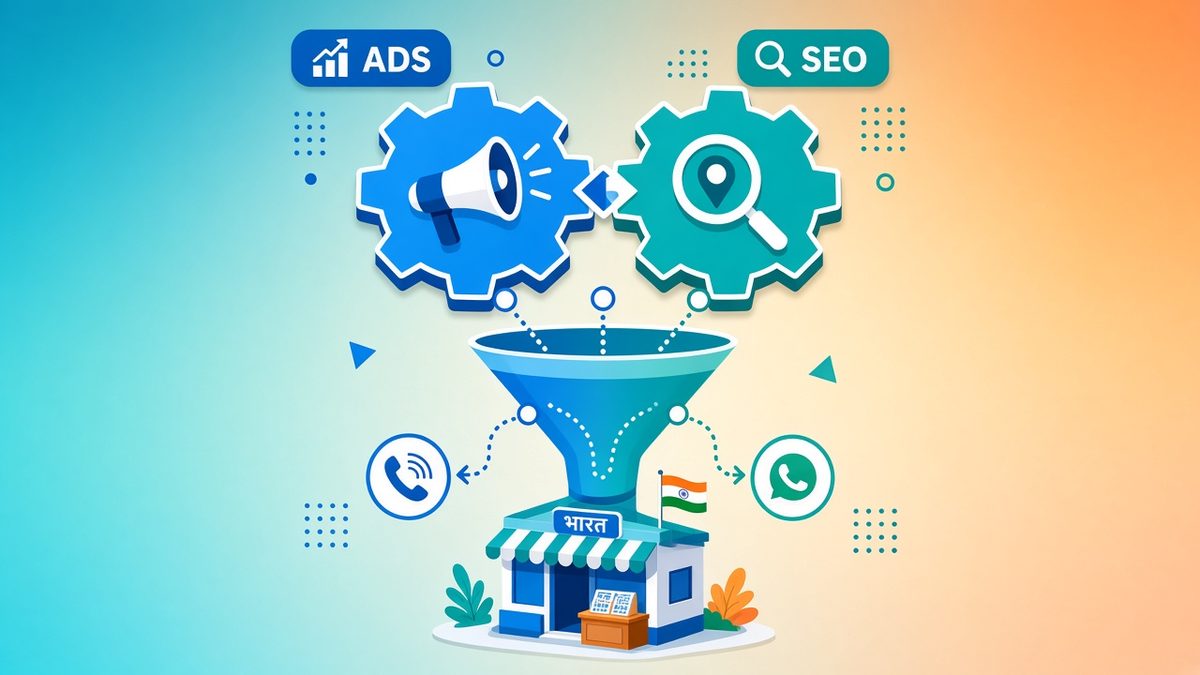
What we've seen work is treating the two as one system. Ads teach you which searches turn into calls. SEO then turns those searches into a steady, cheaper flow of leads. Neither is better in the abstract. Each is better for a specific stage and a specific goal.
How Does Google Ads Work for a Small Business in India?
You bid on search terms like "dentist near me" or "IELTS coaching in Pune". When someone searches, Google runs an auction. If your ad wins, it appears above or below the organic results, and you pay only when someone clicks. That's the pay-per-click model.
Local targeting is the real advantage
Google Ads for small business India works best when you restrict it tightly. You can target a city, a radius around your shop, or specific pin codes. You can also schedule ads for the hours your phone is actually answered. A clinic that shows ads at 2 a.m. with nobody picking up is burning money.
What does Google Ads cost in India?
Costs vary a lot by industry, city and competition, so treat these as typical ranges, not promises:
- Cost per click: many local service keywords fall roughly between Rs. 5 and Rs. 50 per click. Competitive categories such as legal, finance, real estate, education and healthcare in metro cities can run well above that.
- Cost per enquiry: this depends on your click cost and how many visitors contact you. A site that converts 5 in 100 visitors costs far less per lead than one that converts 1 in 100.
- Minimum useful budget: for a local business, Rs. 10,000 to Rs. 15,000 a month in ad spend is often enough to collect meaningful data, though very competitive keywords need more.
On top of ad spend, agencies typically charge a management fee, and you may need a landing page. Results can arrive within days. In practice, though, the first two to three weeks are mostly learning, so don't judge a campaign on day four.
How Does SEO Work for a Small Business in India?
SEO is the work of making your business easy for Google to find, understand and trust. For local firms, SEO for small business India usually has four parts.
The four building blocks
- Google Business Profile: complete categories, services, photos, opening hours and regular posts. For many local searches, this is what appears in the map results.
- Local and service pages: one page per service and area, such as "physiotherapy in Indiranagar" rather than one vague services page.
- Useful content: pages that answer real questions customers ask you on the phone, like fees, procedures, timelines and documents needed.
- Reviews: a steady flow of genuine Google reviews, with replies from you. Reviews influence both rankings and whether a person picks you.
How long does SEO take, and why does it compound?
Three to six months is a typical window before you see steady movement, and longer in crowded markets. That feels slow, but there's a reason owners stay with it. A page that ranks keeps bringing visitors without a per-click charge. Each new page and review adds to the ones before it. Results vary because competitors, your website's age and your city all change the timeline.

SEO vs Google Ads: Side-by-Side Comparison
| Factor | Google Ads | SEO |
|---|---|---|
| Cost | Pay per click, plus management and landing page costs | Mostly time, content and setup, with lower ongoing cost per lead over time |
| Speed | Days to start, a few weeks to optimise | Typically 3 to 6 months for steady results |
| How long results last | Stop when you stop paying | Continue and build, with regular upkeep |
| Control | High: you choose keywords, budget, location and timing | Lower: Google decides rankings, you influence them |
| Skill needed | Campaign setup, bidding, tracking, ad copy | Technical basics, content, local listings, patience |
| Best for | New businesses, offers, testing, urgent leads | Everyday local searches, long decisions, tight budgets |
One nuance the table can't show: ads and SEO appear on the same results page, so a person may see you twice. That repeat exposure tends to build trust, which is one reason the two work well together.
When Should You Start With Google Ads?
Ads are the better first move in four situations.
- You're a new business. You have no reviews, no rankings and no history. Ads get you in front of buyers while the foundations are built.
- You have a seasonal offer. An admission drive for a coaching centre, a pre-Diwali sale or a monsoon AC servicing offer has a short window. SEO can't move fast enough.
- You're testing a new service. A small test budget tells you whether people search for it and whether they enquire, before you invest in a full page strategy.
- You need leads urgently. If a slow month threatens cash flow, ads are the only channel that can respond within the week.
A common mistake here is starting ads with no plan for the clicks. Before you spend, decide what a good enquiry looks like, who answers calls, and how fast you'll reply. Ads that send leads to an unanswered phone simply waste the budget.
When Should You Invest in SEO First?
SEO is usually the stronger first investment when the following apply.
Your service is searched every day
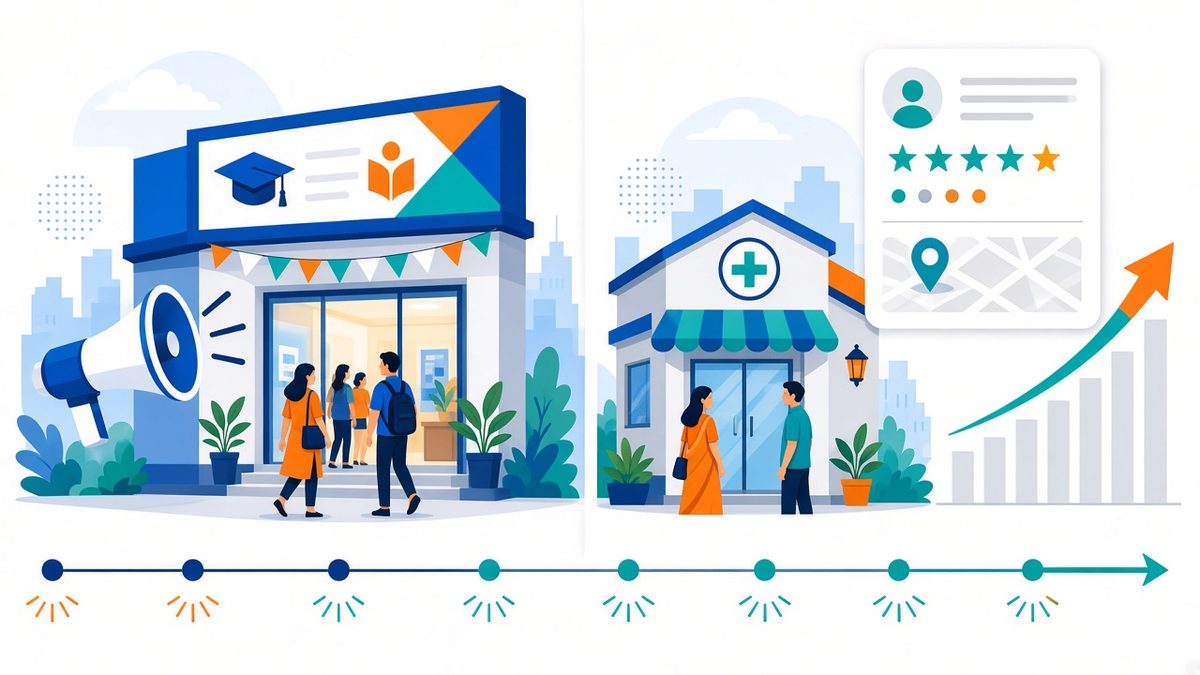
Plumbers, dentists, CA firms, tutors and repair shops get steady search demand all year. If people already search for what you do, ranking in the map pack and the top results is a long-term asset.
Your sales cycle is long
Someone choosing a school, a fertility clinic or an interior designer researches for weeks. They read reviews, compare pages and come back more than once. Content and a strong profile help you stay in their consideration set, while paying for every repeat click gets expensive.
Your monthly budget is tight
If you can only spend a small amount, ads in a competitive category may deliver a handful of clicks and little data. In that case, a well-built website and a polished Google Business Profile often go further. That said, SEO isn't free: it costs time or fees for months before it pays back. Be honest about whether you can wait that long.
How Do You Use SEO and Google Ads Together?
This is where the strongest results come from. The idea is simple: use ads as a fast research tool, then build SEO around what works.
- Run ads on 10 to 20 keywords for four to six weeks and look at search terms, calls and form fills, not just clicks.
- Pick the keywords that produce real enquiries, not merely traffic.
- Build a dedicated service or location page for each winner, with clear pricing guidance, FAQs and local proof.
- Use retargeting to show reminder ads to people who visited but didn't enquire. These visitors already know you, so the clicks are usually cheaper to convert.
- As organic rankings grow, reduce ad spend on keywords where you already rank at the top, and move that money to new ones.
We found that owners who skip the first step often write SEO pages for keywords that sound good but never produce calls. Paid data removes much of that guesswork. If you're new to the tracking side, our walkthrough on setting up conversion tracking for calls and forms is a good starting point.
A Simple 90-Day Plan for Rs. 20,000 to Rs. 30,000 a Month
This is a sample, not a guarantee. Adjust it to your city and category. Assume about Rs. 12,000 to Rs. 15,000 a month goes to ads in the first phase, with the rest on SEO and tools.
- Days 1 to 15, foundations. Fix your Google Business Profile, set up call and form tracking, and build or improve one landing page for your best-selling service. Start a small ad campaign with tight local targeting.
- Days 16 to 30, learn. Review search terms weekly. Add negative keywords to stop irrelevant clicks. Ask every happy customer for a Google review.
- Days 31 to 60, build. Create two or three SEO pages based on the keywords that produced enquiries. Keep ads running on the proven terms and pause the weak ones.
- Days 61 to 90, shift. Add retargeting, publish one or two helpful articles, and compare cost per enquiry from ads against organic calls. If organic enquiries are rising, move a portion of ad budget toward more content.
By day 90, you should know your cost per enquiry, your best keywords and whether your website converts. That clarity is often worth more than the leads themselves.
What Are the Most Common Mistakes?
- Sending ads to the home page. A visitor searching "knee pain treatment" should land on a page about knee pain treatment, with a clear phone number and form.
- No conversion tracking. If you only count clicks, you can't tell which keywords bring customers. Track calls, WhatsApp taps and form submissions.
- Ignoring Google Business Profile. It's free, it drives a large share of local discovery, and many competitors still leave it half-filled.
- Expecting SEO in a month. Quitting at month two is the most expensive SEO mistake, because you pay for the setup and never collect the compounding benefit.
- Judging ads too early. Pausing a campaign after a week of learning data rarely tells you anything useful.
Frequently Asked Questions
Is SEO or Google Ads better for a small business in India?
Neither wins in every case. Google Ads is better when you need enquiries quickly, such as a new business or a seasonal offer. SEO is better for steady, lower-cost leads over time, especially for services people search for daily. Most small businesses do best with a mix that shifts toward SEO as it matures.
How much does Google Ads cost in India for a small business?
It varies by industry, city and competition. Many local service keywords typically cost roughly Rs. 5 to Rs. 50 per click, while competitive fields can cost much more. A budget of Rs. 10,000 to Rs. 15,000 a month is a common starting point for local campaigns, plus any management fee.
How long does SEO take to show results for a local business?
Three to six months is typical for steady movement, though competitive categories and newer websites can take longer. Improvements to your Google Business Profile can sometimes show effects sooner. Results depend on competition, your site's current state and how consistently you publish and collect reviews.
Can I run Google Ads and SEO together on a small budget?
Yes. With Rs. 20,000 to Rs. 30,000 a month, you can put roughly half into focused local ads and the rest into a landing page, Google Business Profile work and a few useful pages. Use ad data to decide which pages to build, then shift spend as organic enquiries grow.
Should a new business start with Google Ads or SEO?
Most new businesses should begin with a small, well-targeted Google Ads campaign while setting up their website and Google Business Profile at the same time. Ads bring early enquiries and keyword data. SEO work started in parallel begins compounding by the time you've learned what converts.
Conclusion: Where Should Your First Rupee Go?
Three points matter most. First, ads buy speed and SEO builds an asset, so match the channel to how urgently you need leads. Second, tracking and good landing pages decide whether either channel pays off. Third, the smartest approach to SEO vs Google Ads is sequencing: use ads to learn, then build pages that capture the same demand for less.
Your next step: this week, write down your top three services, check that your Google Business Profile lists each one, and set up call tracking. If you'd like a second opinion on the split between ads and SEO for your budget, talk to Smarteer about a website and marketing plan built around your city and your numbers.
Smarteer Team
Get a Free Technology Consultation
Talk to our experts about your project — no commitment required.
Book a Call →Build Your MVP in 4 Weeks
Proven framework. Fixed price. From zero to live product.
Learn More →Newsletter
Get the latest insights delivered to your inbox.